MILO WILSON

Project Archive

About Me

Skills

This Website

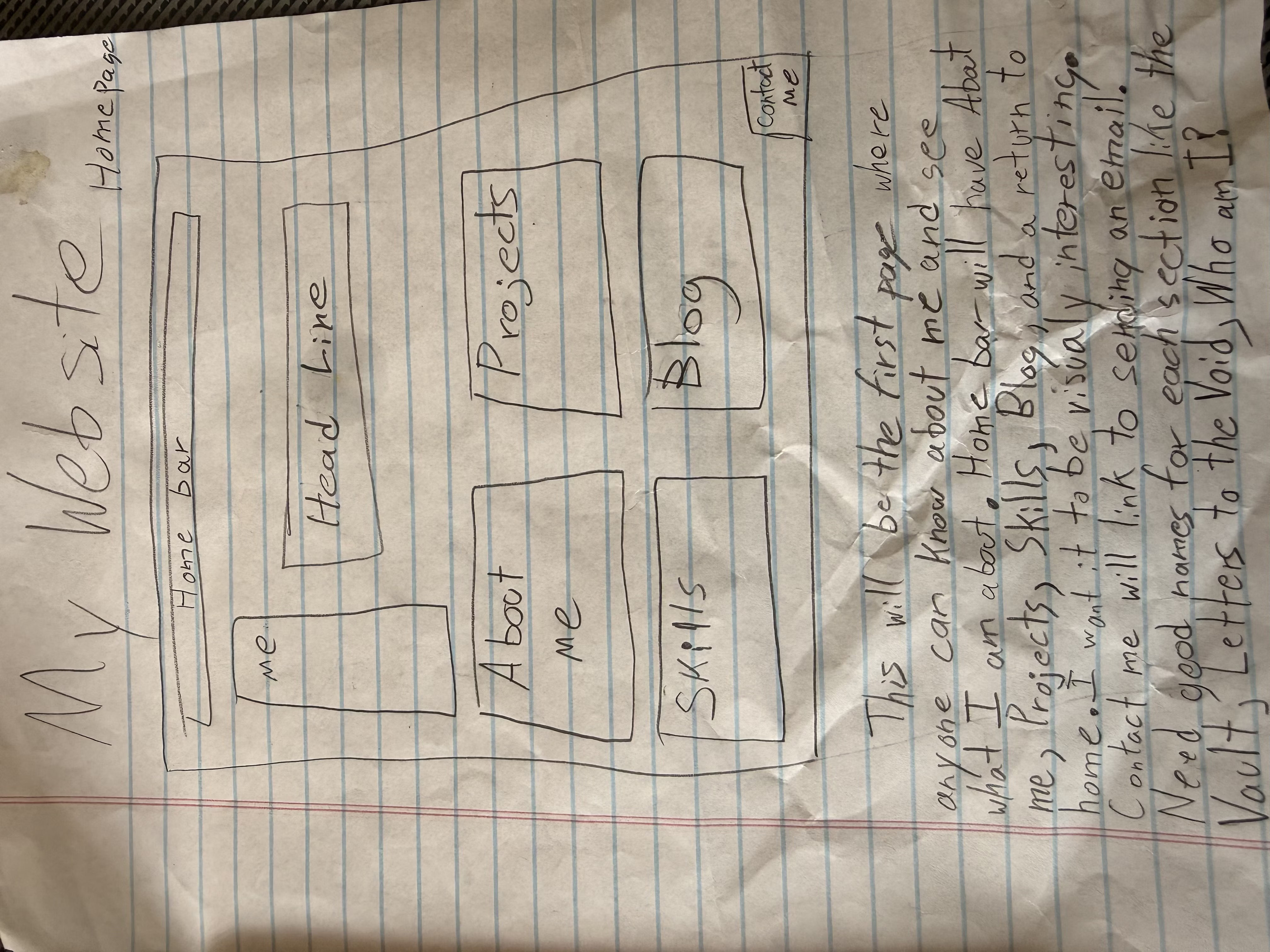
Creating this website has been a great undertaking that has taught me new languages including but not limited to HTML, CSS, and Javascript. Initial phases started with prototyping on paper, laying out what sections I wanted to have. The goal of this website is to have a place where anyone can learn more about me and contact me if they have any questions.


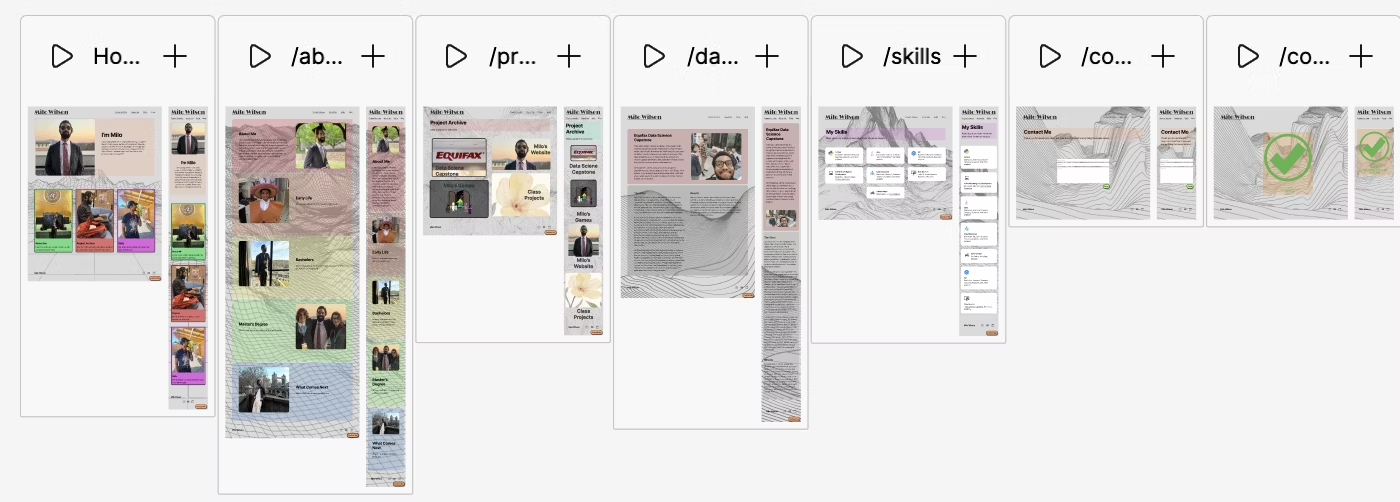
Screen shot of Figma prototype

When translating the project from paper to Sigma there were some changes like changing the project archive and working on making the whole layout pop with some color. Using the background of mountains was intentional to give some visual interest. One of my goals was to make in depth content one click away, to avoid overwhelming a visitor with content. The Skills page is an exception because to me it is not about just having a lot but also having projects to reference for this skills provides good insight for anyone wanting context for my skills. I also took the extra time to make the prototype fully testable so it meet my personal standards.
Figma Prototype


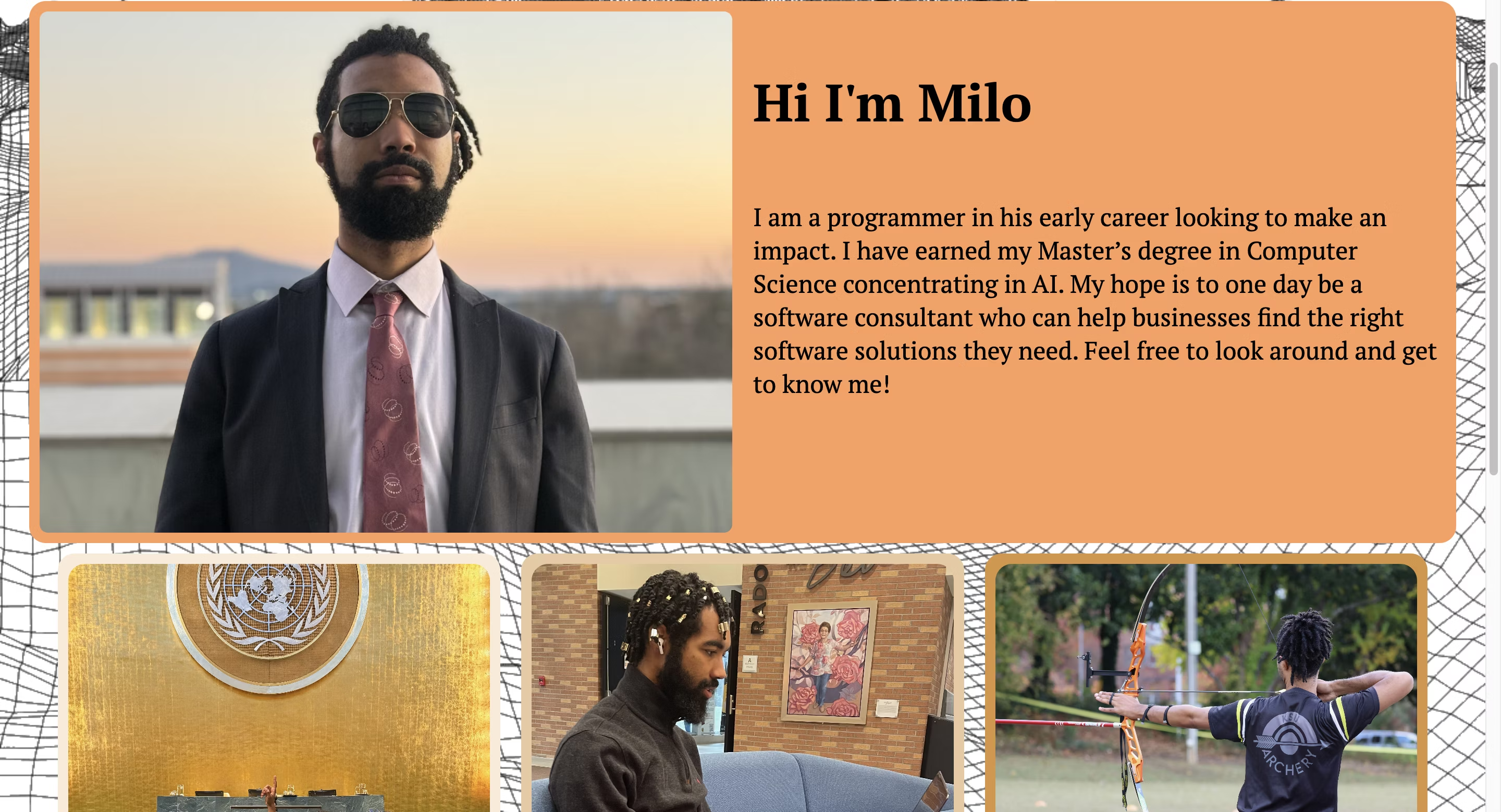
Screen shot of home page

Next was translating the website to HTML. When doing this I saw how little color was in the Figma prototype and decided to go with more bold colors. Choosing orange was intentional because I felt it was a strong color that stood out in the tech space. I also have been working with CSS to add some pop to the website, making the website look appealing. I also skipped the blog section as I thought it was a bit superfluous as this is a website I intend to revisit and keep up to date.

Equifax Data Science Capstone

This was a project where a a group of my peers and I worked alongside Equifax employees to create a data model that would determine the likelihood of a customer to default and for customers to open an account. This data would be used to determine if the customers where capable borrowers and understand if they where in a position to open a new credit account. Unfortunately all the data around this project is proprietary and I am not able to share our findings, slide shows, or go in depth about project specifics. I will talk about what types of work took place and how I had an impact on the project. This was a project where a a group of my peers and I worked alongside Equifax employees to create a data model that would determine the likelihood of a customer to default and for customers to open an account. This data would be used to determine if the customers where capable borrowers and understand if they where in a position to open a new credit account. Unfortunately all the data around this project is proprietary and I am not able to share our findings, slide shows, or go in depth about project specifics. I will talk about what types of work took place and how I had an impact on the project.


The Story

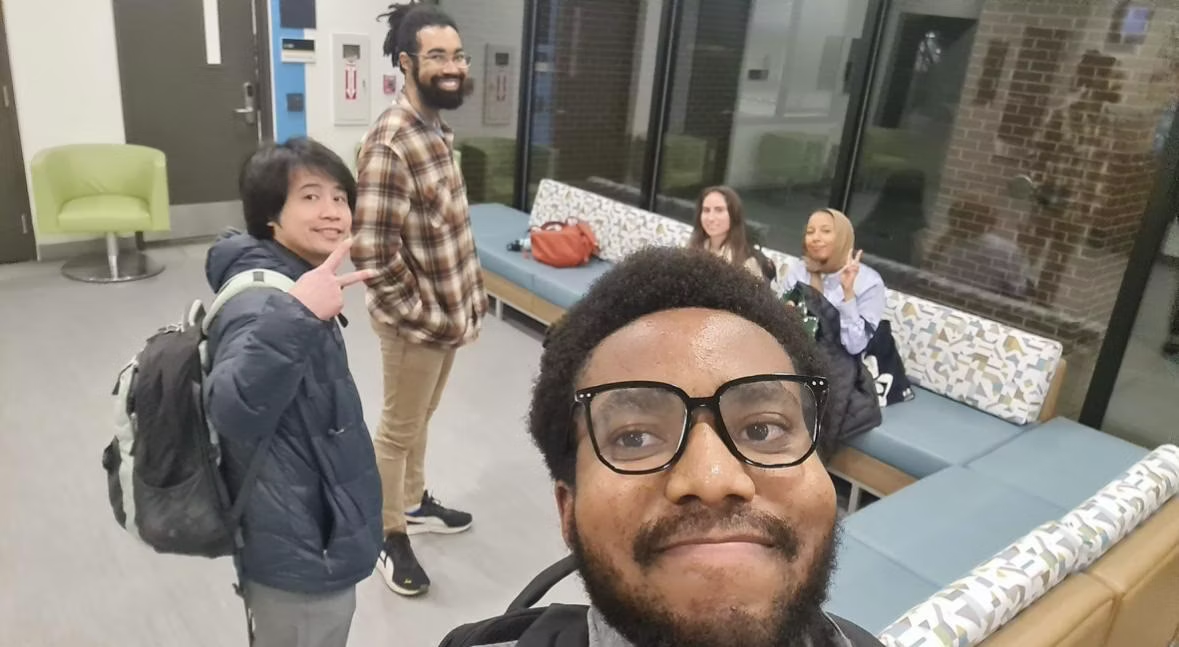
I got the honor to work alongside Amal Elkadir, Nam Huynh, Natalie Jordan, and Ugochukwu Ukeje (Ugo). We all collaboratively worked to understand every line of data we where given. After we comprehended the data we worked to remove irrelevant data, handled missing data. Ugo and Nam drafted early models, Natalie, Amal, and I continued worked on frequency distributions and discovering dependent variables. As we moved out of data exploration and moved into actual model development Ugo and Nam worked to bring the model to life Natalie and Amal continued to analyze the data and bring their findings to the modeling team. Meanwhile I worked on our presentations; I set up practice times to review our presentations before the meeting, made sure that everyone had their information on the slides, and made sure that our presentations where visually pleasing and succinct. Our professor Bill Franks, author of Winning the Room, advised that we take extra care in our presentation of information as it is the primary way any data analyst will convey their findings to shareholders. As the project entered the later stages the teams roles stayed the same. We worked hard and took feedback in stride. At the end we present our final findings and our model to several Equifax employees who evaluated our findings. We where the second best team to present and ended up having a model that was able to produce great results. Through that experience I learned just how much client communication matters, greatly improved my presence in presentations, and was apart of a great team that produced a great model.


Results

We were able to identify several key variables that would identify a customer’s likelihood to open an account and their likelihood to default the year after opening an account. With this data we found several key uses for this information and developed a model for each problem. Both models ended up sporting an above 80% accuracy to correctly identify customer’s behavior. We ended up coming second place in our class with a great model and presentation.

Masters Projects

During my masters degree I worked on many diffrent projects for diffrent classes. Here is a list of some that are of note:


A Study of the Effectiveness of Artificial Neural Networks on Determining the Best Academic Learning Modality for Students Studying Math


Abstract: This project discusses the use of Artificial Neural Networks (ANNs), and its ability to determine suitable learning modalities for students after taking a quiz. Our literature review found that the use of ANNs led to good results for others performing analysis in the same field. The algorithm we designed is able to deduce a student's learning style by answering a few questions. The efficiency that our program displayed leads us to believe that our model can be used in a real time context to give feedback to students about better studying modalities that they can take into consideration after taking a quiz. Overall the model has been effective on training data, and we are hopeful that our research can be used in future work.


Utilizing Particle Swarm Optimization to Create Stronger Convolutional Neural Networks


Project for my Computer vision class, This project was analizing the practicality of utilizing adaptive layers to create better more concise neural networkd.
Abstract: Proposing the development of a particle swarm algorithm to assist in hyperparameter selection. This algorithm tests sets of hyperparameters at a time attempting to narrow down what set of hyperparameters provides the best convolutional neural network. The results from this project led to the assertion that particle swarm algorithms should be utilized for the selection of hyperparameters in larger search spaces than the one in this experiment. While the particle swarm algorithm does lead to significant improvements in algorithms, the time and effectiveness of the algorithm was not worthwhile for the results


Learning to Judge a Dynamic Scoring Function for Lifelong Navigation


Project for my AI Robotics class. This project was looking to develop better navigation patters for robots using lifelong navigation instead of a traditional planners.
Abstract: Autonomous robots navigating complex environments must balance efficiency and safety while adapting to new conditions. Traditional planners like the Dynamic Window Approach (DWA) often exhibit rigid behaviors, limiting performance in dynamic tasks. Lifelong Learning for Navigation (LLfN) improves adaptability by combining classical planning with learned policies, mediated by a scoring function that decides which controller to trust. However, existing scorers rely on fixed heuristics, restricting generalization. We propose a dynamic learned scoring function, D^ψ(s,a), trained on long-term outcomes and integrated with Gradient Episodic Memory (GEM) for continual learning. In experiments across 400 episodes, our approach achieved a 74.25% success rate, reduced collision frequency to 0.072 per episode, and demonstrated improved arbitration between planners (average ratio 0.142 during training, 0.205 in testing). These results support our thesis: a learned dynamic scorer significantly enhances planner arbitration and adaptability compared to heuristic-based LLfN, moving toward practical lifelong navigation in complex environments.


Predicting Air Quality Using Ensemble Learning Techniques


Team project for my Machine Learning class. This study found that the use of ensemble learning models like Random Forest and Gradient Boosting for air quality prediction is promising. Especially due to the noisy and complex high dimensional data of air pollutant concentration.
Milo's Games

I have helped develop many diffrent games in my time during my undergraduate degree. Here is a comprehensive list of the games I helped create and their place on itchio.


Recipe for Disaster


Genre: Cooking, Rougelike
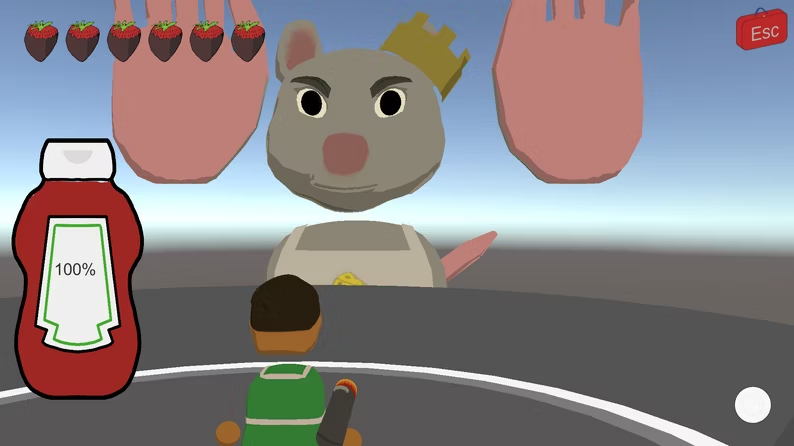
A game where the player goes through increesingly difficult levels with nothing but the food the cook by their side. This was the game I helped develop for my game design capstone.


The Last Sapling


Genre: Action, Platformer
During Global Game Jam 2023 a Team and I worked to develop this game in 42 hours. You play as a last of your kind sapling who has to find his way to a place to plant himself.


Doctor Script


Genre: Narative
A brief naritive game that I made for my Game Naritive class. I made the extra effort to make it an online playable demo. I also got to work with voice actors and present the game at SIEGE 2022, a Georgia game developed convention. You play as a doctor with a particular set of skills that attracts the wrong kind of company.


Festival of Dionysus


Genre: Educational
Explore what the past has to offer and make a have fun doing it! A game a team of peers and I made for out Educational Game Design class. It would constantly be reviewed by students in a 3rd grade class and they and their teacher would let us know what to add or change.


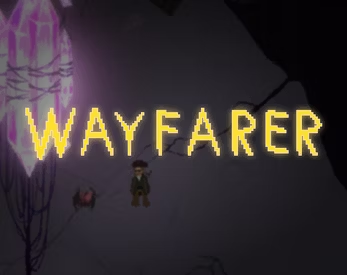
Wayfarer


Genre: Role Playing Game
At Panter Dev, a Georgia State University club, I worked with students to create a in depth vertical slice of a RPG game. Explore the world of Wayfarer and help the denisins of this new world to grow strong.


Money Dungeon


Genre: Base Builder, Idle
For my mobile game design and development I worked with another student to create a mobile game for our Mobile Game Design class. In this game you built a dungeon that adventurers would raid as the dark lord you must build our defences to keeep your ancient treasure.

Home Sleaning Bot Prototype
Home Robot Icon

About


An app prototype that I created for my User Centered Design class. This is a fully functional app protype that is made to controll a fully autonomus robot that is able to compleat all tasks given. I created it by first defining stakehoder expectations, conducting project research, then building a roguh prototype, then building an almost integrated prototype. I decided to go the extra mile and fully connect every part of the app.


Results


The fully connected finished prototype is up on Marvel: Prototype